
How to winterise a swimming pool properly
How you winterise a pool depends on whether it is in-ground or above-ground and whether it is made of liner, concrete, fibreglass or polypropylene. Before winter, also check seemingly minor details, such as where the pipes run, how deep they are and whether they are insulated. Any water left in them will freeze in frosty weather.
Short answer. In-ground pools and rigid-wall above-ground pools spend the winter with water in them. Winterise them once the water stays below 15 °C for good, ideally around 10 °C. Lower the water level to about 10 cm below the skimmer and return jets, drain the equipment completely, add winterising chemical and put floats on the surface.
Inflatable pools and most frame pools, on the other hand, should be drained completely, dried and stored somewhere dry. For a specific model, the manufacturer’s instructions take priority, because the warranty depends on them.
When should you winterise a pool?
Winterise once the water stays below 15 °C for good, ideally around 10 °C, and the nights are not yet freezing every night. In cold water, algae and bacteria barely multiply, so the winterising chemical lasts longer. Albixon states in its instructions that below 10 °C their growth slows to a minimum, and SPATA, the British swimming pool trade association, advises treating the water until it cools to about 7 °C.
Until then, keep the filtration running and check the pH and chlorine, roughly once every 14 days is enough. We explain how long filtration should run in our article how often and how long to run pool filtration.
Some of the equipment will be damaged by frost before the pool itself. Drain plastic solar collectors and the heat pump before the first frost, even if you winterise the pool later.

Why isn’t lowering the water below the skimmer enough?
Lowering the water below the skimmer, the surface debris collector through which water flows to the filtration, is the basic step. You also need to drain everything that holds water and protect the walls from the pressure of ice.
A pool can be made of concrete, steel or fibreglass, and each material copes with frost differently. If the supplier specifies a particular winterising procedure as a warranty condition, follow it.

The pipework is laid differently in every pool. In some, rigid pipe is used, in others there is a section of flexible hose. When the pool is backfilled, the pipes can develop dips where water stays even after draining. If the pipework has no fall, meaning a slope that lets water drain away on its own, you will need to suck it out or blow it through.

Before you start winterising, clean and disinfect the water in the pool. Backwash the filter thoroughly so that no dirt stays in it over winter, where it could go mouldy.
Remember that winterising chemical is not antifreeze! If there is a frost, the water will freeze anyway. The job of the winterising chemical is to limit algae growth so that the water stays clean over winter.
Why does ice damage pipes, the skimmer and the walls?
Water expands when it freezes. The US Geological Survey (USGS) states that ice is about 9% less dense than water, so it takes up roughly a tenth more space. In a pipe, pump or filter tank it has nowhere to go and splits the plastic.
On an open water surface, ice grows sideways and presses on the walls and on everything sticking out of them. That is why the water level should stay below the skimmer and jets, and floats should be placed on the surface to absorb the pressure of the ice.

How to winterise a pool step by step
This procedure applies to pools that spend the winter with water in them. The order matters. The winterising chemical goes in only after lowering the water level and draining the equipment, so that backwashing does not flush it away and all of it stays in the water left in the pool over winter.
- Take out the accessories. Clean and store the ladder, thermometer, chemical floater, portable counter-current unit and vacuum.
- Clean the pool. Scoop out leaves with a net, vacuum the floor, brush the walls and the waterline, and clean the skimmer.
- Adjust the pH and chlorine. We recommend a pH of 7.0 to 7.4 and chlorine of 0.6 to 1.0 mg/l, as stated by Mountfield. After adjusting, let the filtration run for at least 24 hours so the water mixes.
- Lower the water level to about 10 cm below the skimmer and the return jets, through which filtered water flows back into the pool. With a sand filter, use backwashing, which also cleans the filter.
- Disconnect and drain the equipment. Drain the filtration, pump, hoses, heat pump and pipework completely. Store anything that can be removed somewhere dry and frost-free.
- Plug the openings. Fit winter plugs or winterising nozzles in the jets and skimmer, and on above-ground pools, plug the wall fittings.
- Add winterising chemical. Work out the dose from the water volume and follow the label for dilution and how to pour it. The filtration is no longer running, so mix the water by hand, for example by pouring it with a bucket.
- Put floats on the surface or plastic bottles.
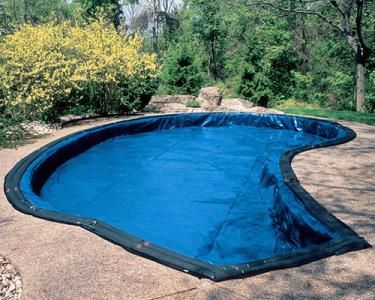
- Cover the pool according to its type, an in-ground pool with a winter cover until spring.
Working out the water volume is simple. For a rectangle, multiply the length, width and water depth: a 3 × 6 m pool with 1.2 m of water holds 21.6 m³. For a circle, multiply 3.14 × radius × radius × water depth: a pool 4.6 m in diameter with 1 m of water holds about 16.6 m³.
How to drain the filtration, pump and pipework
With an in-ground pool, most of the work involves the equipment in the plant pit, the chamber next to the pool that houses the filtration and pump. The points below are based on the instructions from the manufacturer Albixon for a skimmer pool.
- Overflow channel. If you have an overflow pool, remove the protective grating, clean the overflow channel and suck the water out of it.
- Cleaning the filtration. Use the backwash function on the six-way valve, the selector on the filter tank. During backwashing, check how clean the discharged water is in the transparent section of the pipe. Then set the valve to the WINTER position, or between the WASTE and CLOSED positions.
- Draining all the pool equipment. Remove the circulation jets and fit a winterising nozzle, an attachment that lets water run out of the pipework, into one of the openings. Screw winterising plugs into the other openings. Drain the water from the system. No water may remain in any part of the pipework (suction line, circulation circuit, heat pump circuit).
- Filter tank and pump. Loosen the smaller drain screw on the tank and leave it out over winter, but do not loosen the larger screw used for changing the sand. Remove the pressure gauge. Disconnect the pump and store it somewhere warm and dry.
- Checking the valves. Using a wet vacuum or compressed air (Albixon states a maximum of 1.5 bar), check that you have opened all the shut-off valves and that there really is no water anywhere in the equipment.
Leave the unions and valves at the drainage points open over winter, and switch off the main switch and the residual current device so the pump cannot start by mistake.
Cartridge filters on above-ground pools cannot be backwashed. Lower the water level using the pool’s drain valve or a submersible pump. Remove the cartridge, drain the filter housing and replace the cartridge with a new one in spring.
Never drain a pool completely if the manufacturer says it should overwinter with water. Some water must always remain in it.

How to winterise a pool by type
The procedure differs mainly depending on whether the pool spends the winter outdoors with water or is taken down. The table summarises what manufacturers recommend, but for a specific model, its instructions apply.
| Pool type | Over winter | Water level | Equipment |
|---|---|---|---|
| In-ground, liner, concrete, fibreglass or polypropylene | with water, depending on construction and manufacturer’s instructions | about 10 cm below the skimmer and return jets | drain pipework, plug jets and skimmer |
| Above-ground, rigid wall | with water, if the manufacturer allows it | about 10 cm below the skimmer or return jet | disconnect and drain filtration and hoses, plug the jet |
| Above-ground frame pool | usually drain and take down, per manufacturer’s instructions | drain completely | remove and store hoses, skimmer and filtration |
| Inflatable | drain, dry and store | drain completely | drain and clean filtration, store somewhere dry |
Salt water and heating make no difference. A saltwater pool overwinters in the same way as a freshwater pool of the same type, except that the salt chlorinator also needs winterising. The heat pump, counter-current unit and solar heating must always be drained, whether the pool overwinters with water or without.
Above-ground pool with a frame
With above-ground pools, the wall material is what matters. Pools with a rigid steel wall usually spend the winter outdoors with water: Marimex allows this for the Orlando range, and Mountfield for Azuro pools. Mountfield states that their structure can withstand the water freezing completely, so floats or bottles are not needed.
Pools with a tubular frame and liner wall are usually taken down. Bestway strongly recommends taking down its Steel Pro range for winter, and Intex states that its pools must be drained and stored as soon as the temperature drops below 5 °C.
Let the liner dry completely before storing it, as a damp liner goes mouldy. Dust it with talc so it does not stick together and store it somewhere dry; Bestway gives a temperature of 5 to 38 °C. When you put the pool up again in spring, it is also worth thinking about what to put around an above-ground pool.
Inflatable pool
Do not leave an inflatable pool outside over winter. Intex states in its instructions for Easy Set pools that ice can cause the liner to tear suddenly or the pool to collapse. Drain the water through the drain valve, rinse the inside of the liner with clean water so no chemicals remain on it, and deflate the top ring.
Leave the liner in the sun until it is completely dry, then dust it with talc. Throw away the filter cartridge and fit a new one in spring, and store the pump and filter somewhere dry. Marimex advises rolling the liner rather than folding it, refolding it differently now and then during the winter and not storing it under heavy objects, so that it does not develop creases.
In-ground pool
Depending on its construction and the manufacturer’s instructions, an in-ground pool is winterised with water in it. The water balances the pressure of the soil and backfill on the walls, and in liner pools it stops groundwater from lifting the liner.
For concrete, fibreglass and polypropylene pools, the water level and wall protection are specified by the manufacturer or the construction company. The most work goes into draining the equipment in the plant pit. If you are still deciding where to put it, read where to hide a pool sand filter so that it is easy to drain.
Saltwater pool
The salt stays in the water. The difference is the salt chlorinator, a device that makes chlorine from the salt. Remove its control unit and the cell (the part where the chlorine is produced) and store them somewhere warm and dry. Store the probes in storage solution so that they do not dry out.
Do not leave the chlorinator running in cold water. In the manual for its VA Salt Smart unit, Vágner Pool states that the cell degrades prematurely when operated for long periods below 15 °C, and it recommends a different disinfection method for a winterised pool. Check the chlorinator manual to see whether a particular winterising product can be used in salt water.
Pool with a heat pump, counter-current unit and solar heating
Drain the heat pump first. Disconnect it from the mains, close the bypass valves, unscrew the pipes at both connections and vacuum the remaining water out of the heat exchanger (the part the pool water flows through) until it is dry. Then screw the pipes back on, but do not tighten them.
This is how Mountfield describes it in the manual for its heat pumps, adding that frost damage to the heat exchanger is not covered by the warranty. How quickly the pump warms the water up again in spring is covered in our article how long it takes a heat pump to heat a pool.
You can shut down the counter-current unit earlier. Albixon advises draining it as soon as the water drops below 20 °C. Blanking plugs are screwed into its housing, the drain screw is removed from the pump and the pump should be stored somewhere warm. Drain the solar heating panels and store them somewhere frost-free. Mountfield recommends not rolling them up but leaving them laid flat.
When should you not drain a pool, and when should you drain it completely?
In-ground pools and above-ground pools with rigid walls are never drained completely. The water in them balances the pressure of the soil or backfill, so you need to know what the pool’s structural supplier requires.
However, do not leave more water in the pool than a level about 10 cm below the skimmer and return jets. Otherwise ice would press on the skimmer and jets and could damage the pool body.

With liner pools for example, the reason is groundwater or meltwater from snow. In winter, water can be forced under the liner and lift it. If you leave the water level only about 10 cm below the jets and skimmer, the water creates counter-pressure and stops outside water getting under the liner.
The water level depends on whether there is a plug in the return jet. If you plug the jet, a level about 10 cm below the skimmer is enough. Without a plug, lower the level to about 10 cm below the jet and remove its eyeball fitting and ring, Mountfield explains.
The counter-current unit is sealed with blanking plugs, and for lights follow the manufacturer’s instructions. You do not usually need to lower the water level further because of them, but check the level in your pool’s manual.
Inflatable pools and most frame pools are drained completely. Drain the pool water in line with local rules, which Intex explicitly recommends in its manual. Do not let it run into a stream or pond.

Should you cover the pool or leave it uncovered over winter?
Cover an in-ground pool with a winter cover and leave it on until spring. It protects the water from leaves and pine needles, and a sturdy winter cover also stops people and animals falling into the water. If a large amount of snow falls on the cover during winter, it is best to clear it off as soon as possible so that the cover is not overloaded and damaged.
In autumn, cover an above-ground pool with rigid walls with a lighter cover to keep out leaves. Mountfield advises removing the cover as soon as slushy ice starts forming on the surface, drying it and storing it. Snow and frost would damage a cover frozen to the water, so the pool then spends the winter uncovered.
An ordinary pool cover is not a safety cover, as Intex states explicitly in its manual. If you have young children or a dog, fence the pool or use a cover designed to prevent falls.
What should you put in the pool for winter, PET bottles or ice compensator floats?
Floats and bottles work the same way. The air inside is compressed under the pressure of the ice, giving the ice room to expand so the pressure does not go into the walls. For this to work, the float or bottle must be partly submerged, right in the layer where ice forms.
We recommend ice compensator floats that are weighted at the bottom and sit stably in the water. Link them into a chain and lay them diagonally across the surface. Albixon allows 10 to 12 floats for a 3 × 6 m pool.
A cheaper alternative is 1.5 to 2 litre PET bottles. Put a little water or sand in them so that they are partly submerged, close them tightly and tie them into a chain like the floats. An empty bottle just sits on the surface and the ice simply forms around it.
How do you choose a pool winterising product?
A winterising product is meant to limit algae growth over the winter so that the water is not green in spring and the walls are not coated with slime. However, it will not clean water that is already green. Clean it first; you can find out how in our article how to clean algae and other dirt from a green pool.
There are three ways to treat the water for winter, which differ in what they do and what you need to keep in mind.
| Method | What it does | What to keep in mind |
|---|---|---|
| Liquid winterising product | added once during winterising, limits algae growth over winter | dose and dilution vary by product, follow the label |
| Winterising product with anti-scale additive | the same, designed for hard water with a high calcium and magnesium content | manufacturers do not usually give an exact hardness threshold, so measure the hardness |
| Shock chlorination and algicide | disinfect the water before winter and limit algae | pool manufacturers’ manuals add a winterising product after them |
Doses of different winterising products are not comparable, as the products vary in composition and concentration. Labels give anything from 200 ml to 1 litre per 10 m³ of water. Albixon points out that the dose is often given per 1 m³ and that the water is only protected for a limited time.
As examples, we give two products from the manufacturer PWS. The details come from product pages checked on 1 October 2026, and you can find the full range among the Chlorito winterising products.
Zazimovač PWS
A liquid product in 1, 2, 3 and 5 l packs. The dose is 200 to 500 ml per 10,000 l of water depending on water hardness, and it is applied when the water temperature is below 15 °C. Before use, it is diluted at roughly 1 part product to 5 to 10 parts water and poured along the walls. It is a biocide with the hazard statement H411 Toxic to aquatic life with long lasting effects.
Use biocides safely. Always read the label and product information before use.
Zazimovač Gold PWS
Designed for hard water with a high calcium and magnesium content, in 1, 2, 3 and 5 l packs. The dose starts at 500 ml per 10,000 l of water, it is applied at a water temperature of 15 °C or lower, ideally at 10 °C, and it is diluted in the same way as Zazimovač PWS.
The manufacturer does not state the hardness level at which Gold becomes worthwhile, and even the standard Zazimovač PWS is dosed according to hardness. Gold is a biocide with the signal word Warning and the hazard statements H315 Causes skin irritation, H319 Causes serious eye irritation and H411.
Use biocides safely. Always read the label and product information before use.
How to handle winterising products safely
For products with the H315 and H319 statements, such as Zazimovač Gold PWS, wear gloves and eye protection when diluting and pouring. Store chemicals out of the reach of children and do not mix them in the same container with other pool products.
The hazard statement H411 means the product is toxic to aquatic life. So do not pour the concentrate or any leftovers into drains, a stream or onto the ground, and dispose of the empty container as instructed on the label. Drain pool water containing diluted winterising product in line with local rules.
The most common mistakes when winterising a pool
In spring, one of these mistakes is the most likely to show up.
- Water was left in the equipment. A sag in the pipework or a pump drain screw left in place is enough for frost to burst them.
- The filter was left connected to the pool. Water in the pump, filter tank and hoses freezes. Marimex lists this among the most common mistakes.
- The water level was left high. Ice at the level of the skimmer and jets presses on the plastic parts and walls.
- A pool meant to winter with water was drained. Groundwater can lift the liner and frozen soil presses on the walls.
- Winterising in warm water. Algae still grow in it and the winterising product is used up before winter arrives.
- An above-ground pool under a cover frozen to the water. Snow and ice damage the cover.
A mistake usually only shows up in spring. So after winterising, go over the equipment once more and take photos of what you opened and plugged and where. When you start the pool up again in spring, you will know what to put back.
What should you do with your pool over winter and in spring?
Do not leave a winterised pool completely unattended. Lift a corner of the cover from time to time and check the water, as the British SPATA advises, and after a while make sure the pipes are still clear.
Clear snow off the winter cover. After a thaw, check that the water level is still below the jets, because rainwater and melting snow can raise it, and that the floats have not drifted to the edge.
What if the winterising agent does not last until spring?
Protection with a winterising agent only lasts for a limited time. The greatest risk comes in a warm early spring, when the water warms up before you get the pool running again. Albixon recommends reopening the pool as soon as the water reaches 10 °C, because algae and bacteria then multiply quickly.
So check the water now and then in February and March. If it starts to turn green or cloudy, do not wait until April. Remove the debris, measure the pH and chlorine and disinfect the water. If there is still a risk of frost, do not switch on the equipment and mix in the chemicals by hand.
How do you reopen a pool in spring?
In spring, work in reverse order. Take off the cover and let it dry before storing it, remove the floats, take out coarse debris, remove the plugs and stoppers, reinstall the equipment and top up the water. Marimex advises de-winterising in March and April, once the air temperature no longer drops below freezing.
Then measure and adjust the pH and chlorine, and let the filter circulate the entire volume of water at least once or twice. You will find a detailed guide in the article how to clean a pool after winter without unnecessary mistakes.
When should you leave winterising to a professional company?
You can winterise an above-ground pool with hoses and a filter next to the pool yourself. However, if you are not sure, it is always better to turn to a professional who will help you winterise your pool. Winterising by a technician is offered, for example, by the manufacturer Albixon.
Call a service mainly if you do not know where the pipes run and whether they slope towards the plant room, if you have a heat pump, salt electrolysis or an overflow pool, and if you are unsure about the wiring in the plant room. Winterising can also be combined with getting a cottage ready for frost; you will find tips in our article how to winterise a cottage.
Leave a Reply