
Top 8 most common beetles in the home
Most people spend their whole lives trying not to be surprised by beetles in their home. Even if you are a stickler for cleanliness, these pests will not necessarily pass you by. You may have trouble with flour beetles in the flour, ladybirds on the windows in autumn, and fruit flies or aphids can turn up just as unexpectedly.
Even if you fit special screens to your windows, take out the rubbish regularly and seal every crack and gap, beetles will often still find their way in. However, to choose the right method of getting rid of them, it helps to know which beetle you are actually dealing with.
The short answer. The beetles most often found in homes are small ones that live in kitchen food stores, namely cigarette and drugstore beetles, flour beetles, grain weevils and grain borers, followed by carpet beetle and larder beetle larvae in textiles, longhorn beetles in roof timbers and woodworm in furniture. In autumn, more ladybirds and shield bugs appear, but they only spend the winter with you. For food pests, it is usually enough to throw away the infested food, wash the shelves and store food in sealed containers. For longhorn beetles in roof timbers, call a professional company.
Small black and brown beetles in the home, what are they?
Most of the beetles you find at home measure just a few millimetres and look alike at first glance. The quickest way to tell them apart is by where they appear and what they damage around them.
- Kitchen and pantry. Small brown beetles in flour, spices, tea or cereals are usually cigarette or drugstore beetles, flour beetles or grain borers. A dark little beetle with an elongated snout in grain is a grain weevil.
- Windows and windowsills in autumn. Harlequin ladybirds, which are beetles, and brown marmorated stink bugs and western conifer seed bugs, which are true bugs, not beetles. All of them are looking for somewhere to spend the winter.
- Bed, carpet and wardrobe. Small black or spotted beetles and hairy brown larvae are most often carpet beetles and larder beetles. If something is really biting you in bed, think rather of bedbugs, which are not beetles.
- Beams, floors and furniture. Round or oval exit holes in wood with fine dust beneath them point to longhorn beetles or woodworm.
- Bathroom, cellar and damp corners. Silverfish, woodlice and booklice. They are not beetles, but their presence points to damp.
If you are not sure, take a close-up photo of the beetle next to a ruler or a coin and note down where you found it. The size and the place where it was found will help you, and a professional company if you need one, to identify it.
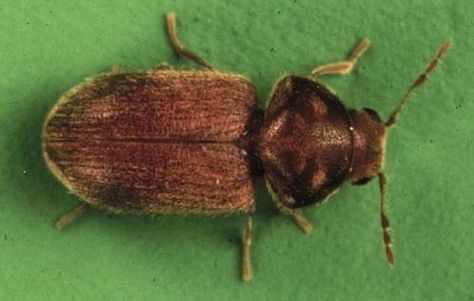
1. Cigarette beetle
They are most often found in warehouses and food processing facilities. However, you can come across them in your home too. These beetles attack spices, sweets and other dry foods. They are usually found in the kitchen and the pantry.
They measure around 2 to 3 millimetres and have a yellowish-brown to rusty-brown body covered in fine hairs. When you discover them, it is important to clean up everywhere they have been. If they keep coming back after a thorough clean, call in a specialist company.
It is easy to confuse with the drugstore beetle, which we describe below. Penn State Extension (Pennsylvania State University) states that the cigarette beetle is stockier, with smooth wing cases and antennae of the same thickness along their whole length. The drugstore beetle is more elongated and has distinct lengthwise grooves on its wing cases. According to the Agromanuál pest atlas, the cigarette beetle mainly attacks dried plant products, such as spices, medicinal herbs and tobacco.
2. Longhorn beetles
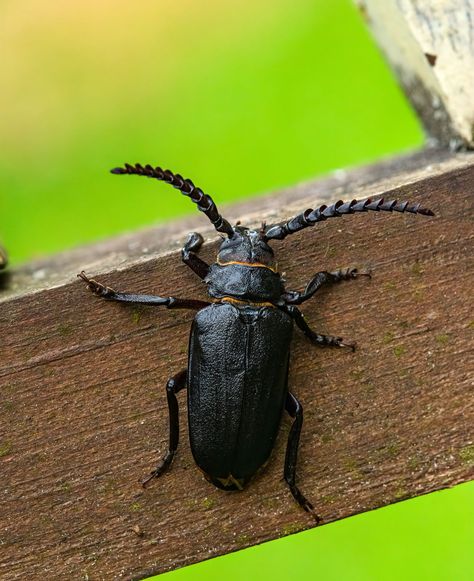
They are wood-boring pests. Their larvae eat wood and bore tunnels in it. According to Penn State Extension, the old house borer, the most common of them in homes, only chooses softwood, such as pine, spruce and similar trees.
If you hear a quiet crunching or clicking in wood, it may be longhorn beetle larvae; Penn State Extension describes this sound. However, mice also make noises in ceilings. The extent of the damage also matters. They attack beams, wooden floors and various pieces of furniture.
So how do you fight them? Wood preservative treatment against pests mainly protects wood that is not yet infested. Movable items, such as valuable furniture or sculptures, can be treated with gamma radiation at a specialist facility.
One such facility is run, for example, by the Central Bohemian Museum in Roztoky u Prahy. Even large pieces of furniture fit into its irradiation chamber, the treatment takes 24 to 48 hours and no chemical substances remain on the items.
However, you cannot take the roof beams away anywhere. According to Penn State Extension, larvae of the old house borer develop in wood for 3 to 15 years. In the Czech Republic, roof structures are often treated with hot air. Jaroslav Solař from VŠB-Technical University of Ostrava (TZB-info, 2013) describes that the wood must be heated through its entire cross-section to at least 55 °C for at least an hour.
However, hot air does not protect against a new infestation, so the wood then needs further protection, for example with a protective coating. The method will be chosen by a professional company. If it works with highly toxic substances, its worker must have completed a special professional course under Section 58(3) of Act No. 258/2000 Coll.
Smaller exit holes in furniture usually belong to woodworm. We describe how to recognise them and what to do with an infested piece in the article how to get rid of woodworm in furniture.
3. Confused flour beetle
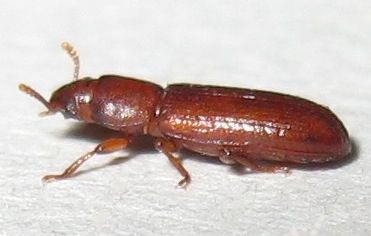
They are very fond of human homes. They measure around 3 millimetres and look like caraway seeds. If you disturb them, do not be fooled: they like to play dead. They most often cause damage in the kitchen, where they spoil food with their droppings.
In fact, you can bring them home in flour or sugar. Throw away infested food in a sealed bag, as Oregon State University Extension advises, and transfer the rest of your supplies into containers with tight-fitting lids.
4. Ants
Ants are not beetles; they belong to the Hymenoptera, the order of insects that includes bees and wasps. We have included them in the list because people often associate them with small beetles in the home. They appear both in the garden and in the kitchen. In the Czech Republic, the most common is the black garden ant, which is greyish-black in colour. In the home, they like everything. They eat leftovers of stored food and can also give an unpleasant bite.
Home remedies recommended against them include baking powder, vinegar mixed with water or toothpaste on window frames. However, these will not destroy the nest with the queen.
Michael F. Potter of the University of Kentucky points out that the most common mistake is to spray only the ants you can see. Workers from the nest then keep coming. Baits are more effective, as the workers carry them back to the nest and feed them to the queen. Do not spray anything around the baits or wipe them with cleaning products, so that the ants do not start avoiding them. Keep baits out of reach of children and pets and follow the label.
Leave small, pale ants that wander all over the house to a professional company. According to the University of Florida (IFAS), the pharaoh ant, whose workers measure 1.5 to 2 mm, has settled in heated buildings in colder countries. When disturbed, for example by a repellent spray, its colonies split into new nests, which is why baits are used against it.
According to the same source, in hospitals the pharaoh ant can carry more than a dozen disease-causing agents, such as salmonella and staphylococci. You can help yourself by clearing up crumbs, spilt sweet drinks and pet food bowls, and by sealing gaps around thresholds, windows and pipe openings. Further methods are summarised in the article how to get rid of ants in the garden and in the home.
Most of these beetles measure just a few millimetres, yet it is worth knowing them.
5. Drugstore beetle
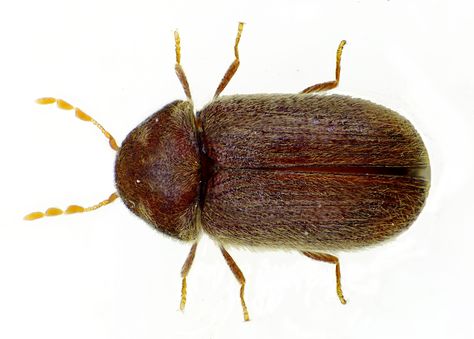
It prefers to attack cereals, packaged foods, animal and spilt products, and old books. It measures around 3.5 millimetres in length. They cause irreversible damage in the form of tunnels, and also in dried herbs.
According to Penn State Extension, females lay their eggs one at a time in almost any dry organic material, and the whole development from egg to adult can take 40 to 50 days. A single forgotten bag is therefore enough for the beetles to spread to other food supplies.
6. Booklice
Booklice are not beetles but a separate group of small insects that people easily confuse with little beetles. They come in various colours. They have a large head compared with their body. They feed mainly on mould, starches and insect remains. They are also fond of cereals and flour products.
They are not welcome in the bookcase either. Theresa Dellinger and Eric Day of Virginia Tech (Virginia Cooperative Extension) state that booklice also feed on starches in books, paper and fabrics, can damage them over time and are considered pests in museums and libraries.
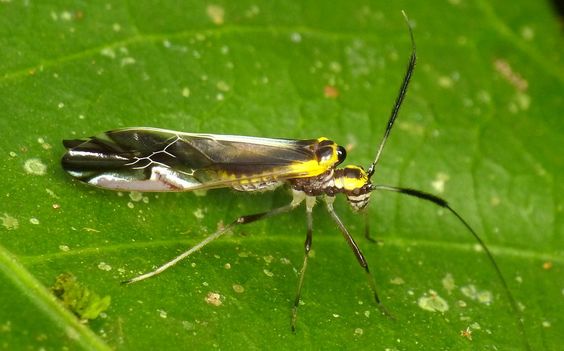
Booklice, silverfish and woodlice point to damp
Booklice, silverfish and woodlice are not beetles, but they appear in homes for the same reason: damp. According to the Virginia Cooperative Extension mentioned above, booklice feed on mould and yeasts, which thrive in damp conditions. According to Michael Waldvogel of North Carolina State University, silverfish seek out cool, damp places, hide in cracks during the day and at night nibble paper, fabrics and the glue in book bindings.
Woodlice are land-dwelling crustaceans. Entomologists from the University of Kentucky (Katz, DeVries and Larson) write that they can hardly survive in a home without high humidity. They crawl into ground floors and cellars from outside, so it helps to clear leaves, mulch, stones and flowerpots away from the entrance and the foundations.
What works against all three is mainly keeping things dry, not chemicals. Fix dripping pipes and ventilate, and in the bathroom and cellar a dehumidifier and sealing gaps will help. We explain separately how to reduce humidity in your flat without spending a lot.
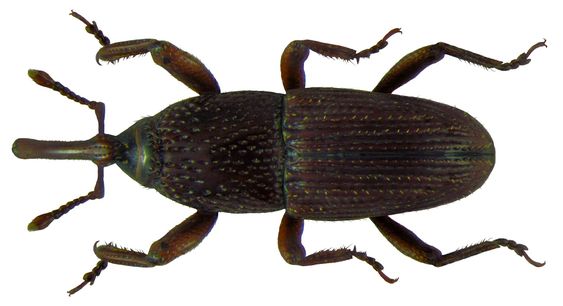
7. Granary weevil
It mainly damages stored grain. The beetles feed mostly on grains. You can recognise them by their elongated snout and dark colouring.
The granary weevil cannot fly, so it only gets into your home in grain you have bought. If you find it, check all your stocks of grain, flour and pasta and throw away anything infested, as we describe below in the section on the kitchen.
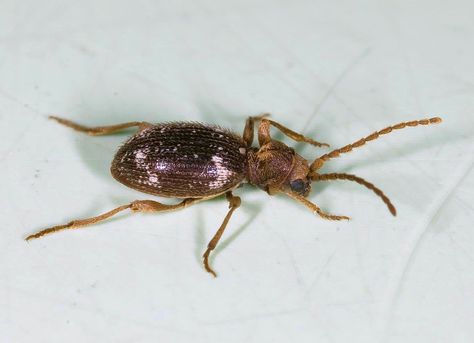
8. White-marked spider beetle
A small brown beetle measuring around 4 mm. It has an oval body. They mainly attack dried foods, such as salami or dried herbs. From a distance they may remind you of small spiders.
Like woodworm beetles and the mealworm beetle, it is a stored-product pest, so the same approach applies. Find the source, throw away infested food and store the rest in sealed containers.
Beetles in the kitchen and in flour, what to do?
Five of the insects on our list, namely both woodworm beetles, the mealworm beetle, the granary weevil and the spider beetle, are stored-product pests. They usually get into your home with your shopping. Penn State Extension points out that even an unopened pack, such as a baking mix, can be infested without anything showing on it.
- Check all your stocks, not just the flour. Also spices, teas, dried fruit, cereals, pulses and pet food. Tie infested food into a bag and throw it away.
- Vacuum the shelves, including joints and corners, ideally with a crevice tool, and wipe them with water and washing-up liquid. Then throw away the vacuum cleaner bag.
- Freeze any suspect stocks. Oregon State University Extension advises leaving them in the freezer for at least 4 days, and Lee Townsend from the University of Kentucky gives a temperature of −18 °C (0 °F).
- Store them in containers made of glass, metal or rigid plastic with a tight-fitting lid. Neither paper nor thin plastic bags will stop beetles.
- Do not buy damaged packs and do not keep unnecessarily large stocks.
Insecticide spray does not belong in a kitchen cupboard. Oregon State University Extension does not recommend insecticides against insects in food because they cannot reach the beetles inside the packaging. Lee Townsend adds that killing the adult beetles is not enough until you find the source. If the beetles keep coming back even after a thorough clean, look for a forgotten stock, such as an old bag of spices or pet food in another room.
Are beetles in food dangerous? According to Oregon State University Extension, stored-product insects are not known to spread diseases or parasites, and eating infested food that has been cooked or frozen does not cause problems. However, the hairs of some beetles can irritate the mouth, throat and stomach. So do not use flour that has had beetles in it, and throw it away in a sealed bag along with the other infested food.
Why do ladybirds and shield bugs appear in homes in autumn?
In autumn, beetles and bugs that do not eat your food also turn up in homes. They are just looking for somewhere to spend the winter. Penn State Extension describes how ladybirds gather on houses mainly on sunny, warm afternoons after a cold night.
They get inside through gaps around windows, doors, cladding and pipe openings.
Harlequin ladybird
It comes from East Asia. According to Oldřich Nedvěd from the University of South Bohemia (Vesmír, 2007), it was first recorded in the Czech Republic in 2006 around Prague and Plzeň. In North America, he states that ladybirds crawl into farmhouses by the hundreds through gaps in window frames.
It does not breed indoors, and in spring it tries to get back outside.
Penn State Extension states that disturbed ladybirds release a smelly yellow fluid from their leg joints that stains walls, and they occasionally bite, which can range from mildly annoying to painful. In sensitive people, ladybirds in homes have also been linked to allergic problems, such as a runny nose with conjunctivitis, or asthma.
A vacuum cleaner works best. Seal gaps with silicone sealant and do not spray insecticide into wall cavities.
Brown marmorated stink bug and western conifer seed bug
Most people think the brown “stink beetles” on windows are beetles, but they are actually shield bugs. The brown marmorated stink bug is an invasive species from East Asia.
Petr Kment, Alexandra Hánová and Martin Vašíček described in the magazine Živa (2019) that the first specimen in the Czech Republic was caught in August 2018 by a light trap of the Central Institute for Supervising and Testing in Agriculture (Ústřední kontrolní a zkušební ústav zemědělský) in Luková near Přerov. In December of the same year, it was already found in a flat in Prague-Holešovice, most likely brought in with fruit and vegetables from a market.
According to Penn State Extension, stink bugs do not breed indoors and do not damage anything. But if you squash or vacuum up several at once, their smell is quite noticeable. So it is better to collect them carefully in a jar or on a piece of paper and take them outside.
Penn State does not recommend spraying indoors. Larvae of carpet beetles, which we write about below, could feed on dead bugs inside the walls.
The western conifer seed bug is another brown bug that overwinters under bark, in birds’ nests and in houses. Penn State Extension describes it as merely a nuisance insect: it does not usually bite people and poses no health risk. The best defence against both species is to stop them getting inside, which means sealing gaps and fitting mesh over vents.
Carpet beetles and larder beetles, beetles in your bed, carpet and wardrobe
Carpet beetles and larder beetles belong to the group known as carpet beetles. At home you will find them as small dark or spotted beetles on windows and as hairy brown larvae in carpets, wardrobes or under the bed. According to David Shetlar from Ohio State University, the adults are good fliers, feed on pollen from flowers outdoors and are attracted indoors by light. You can also bring them in with cut flowers.
The larvae do the damage. They feed on wool, fur, feathers, silk, felt and even dead insects and the contents of bird and mouse nests. They hide behind skirting boards, in ventilation ducts, drawers, carpets and upholstered furniture. We describe them in more detail with photos in our article how to identify the most common beetles and insects in homes.
Larder beetles do not bite. However, Steve Jacobs from Penn State Extension describes how the larval hairs can cause an itchy rash that people mistake for bites. Usually only people who have been in contact with the hairs for a long time, typically years, become sensitive to them. If something really is biting you at night, think bed bugs instead.
Thorough vacuuming of carpets, mattresses, skirting boards and areas under furniture helps, as does washing or dry cleaning woollen items and storing them in sealed containers. Woollen items that cannot be washed can be frozen. Dong-Hwan Choe from the University of California (UC IPM, 2020) advises sealing them in a plastic bag and leaving them in the freezer for 2 weeks at below −8 °C (18 °F), which kills all life stages.
Also find the source, such as an old woollen blanket, forgotten pet food or a nest under the roof. If the larvae do not go away, consult a professional pest control company.
How to get rid of beetles at home and when to call pest control
For most beetles in the home, the same order applies. First identify what you are dealing with, then remove the source of food or moisture, clean thoroughly and seal the ways in. Chemicals come last. If you do use them, follow the product label, meaning the dosage, hand and eye protection, and the rules on where you may and may not spray. Never spray on food, dishes or places children and pets can reach.
The Public Health Protection Act (zákon o ochraně veřejného zdraví, No. 258/2000 Coll.) distinguishes two types. Routine preventive pest control is something everyone does themselves as part of cleaning. Special pest control, meaning targeted extermination of an increased occurrence of harmful insects and other arthropods, may under Section 58 only be carried out by a person with a valid certificate of professional competence. Rodent control covers rodents, such as mice and rats.
In a block of flats, it is good to know who is responsible for what. For living spaces, under Section 57 the property owner or the owners’ association is obliged to arrange special pest control when there is an increased occurrence of pests. So if cockroaches or ants are spreading between flats, contact the building management, as treating a single flat is usually not enough. If you rent, contact your landlord, because the obligation under Section 57(2) lies with the owner.
Call a professional company mainly in these cases:
- wood-boring insects in beams, the roof structure or the floor,
- bed bugs, cockroaches and ants that keep coming back after baits or cleaning,
- food pests or larder beetle larvae that keep appearing even after a thorough clean,
- insects in a home with small children, allergy sufferers or pets, where you want to use as few chemicals as possible.
Ask what product the company will use, how long you must stay out of the flat and whether the treatment needs to be repeated. The company should also be able to show you a certificate of professional competence for special pest control.
If reading this has made you itch all over, don’t worry, cleaning and well-sealed stocks will deal with most beetles. Just remember that beetles in food, wood and textiles are a problem that needs to be dealt with as soon as possible. And once your home is peaceful again, take a look at how to create an interior you will enjoy living in.
Leave a Reply