
How solar panels work in winter, plus owners’ experience
Solar panels do produce electricity in winter, just much less than in summer. There is less sunlight in the winter months, and the cold only slightly softens this drop. Thanks to the cold, the efficiency of solar panels is up to 20% higher in winter than in hot weather. However, the cold does not make up for the smaller amount of solar radiation, and neither does snow, which reflects only a little extra light onto the panels.
Short answer. Solar panels work in winter, they just produce less. According to the PVGIS database, run by the European Commission’s Joint Research Centre (JRC), 1 kWp of panels in Prague tilted at 35° facing south produces an average of 36 kWh in December and 131 kWh in June. November to February together account for roughly 16% of annual output. Frost does not harm performance, as a cold panel works more efficiently, but output is held back by short days, clouds and snow.
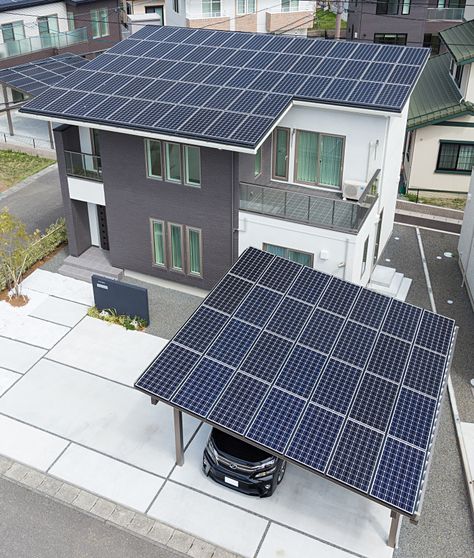
So how do solar panels work in winter?
They produce the least electricity from November to January, with December usually being the weakest month. This is because the days are shorter and there is less sunshine. You may therefore wonder what solar panels are good for in winter at all. However, we spend more time at home in winter than in summer, and every kilowatt-hour you produce and use straight away counts. How much of your winter consumption they cover depends mainly on the system’s output and on whether you heat with electricity.
One advantage is that they work even under overcast skies, but they are no miracle. In poor conditions, the output of solar panels drops sharply in winter. In really thick fog, rain or heavy snowfall, they produce almost nothing.
How much do solar panels produce in winter, month by month?
The PVGIS database mentioned above gives a reliable estimate for a specific location. It uses satellite measurements of solar radiation from 2005 to 2023. For the table, we entered 1 kWp of south-facing panels, a tilt of 35° and typical system losses of 14%.
| Month | Prague, kWh per month per 1 kWp | Prague, kWh per day per 1 kWp | Brno, kWh per month per 1 kWp |
|---|---|---|---|
| November | 42 | 1,4 | 43 |
| December | 36 | 1,2 | 35 |
| January | 40 | 1,3 | 42 |
| February | 61 | 2,2 | 63 |
| June, for comparison | 131 | 4,4 | 133 |
| Whole year | 1 093 | 3,0 | 1 127 |
For a 5 kWp system, multiply the values by five. In Prague, this works out at around 180 kWh per month in December, an average of just under 6 kWh a day, compared with over 650 kWh in June. December and January together account for only about 7% of annual output, and from February onwards output rises quickly.
These are long-term averages, and an actual winter can differ considerably. According to the same database, in Prague a horizontal surface received 20 to 27 kWh of solar radiation per m² in December in individual years from 2010 to 2023, and 24 to 37 kWh in November. A sunny November can therefore bring half as much solar radiation again as a cloudy one. So judge your own system over the whole year, not by a single winter month.
Do solar panels produce electricity when it is cloudy?
When it is cloudy, diffuse light reaches the panels. This is light that is reflected or refracted by particles in the atmosphere and does not shine directly from the sun onto the panels. Solar panels can produce electricity from this light too, but as we have already mentioned, do not expect miracles. There will be less of it. Energy production also depends on many factors, including the angle of incoming solar radiation, the thickness of the atmosphere and weather conditions.
Solar panels produce electricity even in winter, although not at full output. With a suitable tilt and position for the panels, and the option of using surplus electricity from the summer through a virtual battery (more in the section on batteries), a solar power system can still help cover a household’s energy needs.
How to deal with snow on the panels
Snow and frost on solar panels can temporarily affect their efficiency, but they are not usually a serious problem. Good-quality panels are designed even for extreme weather conditions. Panels are tested to the international standard IEC 61215. The test load is the design load multiplied by a safety factor of at least 1.5. The basic test at a pressure of 2,400 Pa therefore corresponds to a design load of 1,600 Pa. More robust panels tested at 5,400 Pa have a design load of 3,600 Pa, which is roughly 370 kg per m².
Based on the snow densities used in the European standard for snow loads, ČSN EN 1991-1-3, this equals about 0.9 m of wet snow or 1.8 m of settled snow. However, this only applies if the panels are installed according to the manufacturer’s instructions.
In most cases, panels are installed at a tilt of 15 to 50°, and this, combined with their smooth surface, helps snow and other material stuck to them slide off on its own. Some light gets through a thin layer of snow and the panel produces a little, but under a thicker layer it produces nothing. The panels warm up as they do so, which helps snow and frost melt away.
Is it worth clearing snow off the panels?
Usually not. Researchers from the US National Renewable Energy Laboratory, NREL (Marion et al., Solar Energy journal, 2013), measured snow-related losses on six solar power systems in Colorado and Wisconsin. In individual winter months, they reached up to 90%, but over the whole year only 1 to 12%. In the Czech Republic, moreover, December and January provide only a small share of annual output, as the table above shows, so even fully snow-covered panels lose little of their annual output at that time.
Do not climb onto the roof because of snow, as the risk of injury is far greater than the loss of a few kilowatt-hours. Snow usually slides off panels on a pitched roof within a few sunny days. If you want to brush it off, only use a tool with a soft head on a telescopic pole from the ground. Never scrape with a metal shovel or pour hot water over the panels. One panel manufacturer’s cleaning instructions require water whose temperature differs from that of the panel by no more than 20 °C.
Watch out for the area below the gutter, as snow slides off tilted panels all at once and in large amounts. Problems can arise on flat roofs with panels at a low tilt, where snow stays for a long time and puts load on the structure. The Fraunhofer Institute for Solar Energy Systems (Fraunhofer ISE) states that a steeper panel tilt reduces losses from both snow and soiling. After heavy snowfall on a flat roof, it is therefore worth calling the installation company.
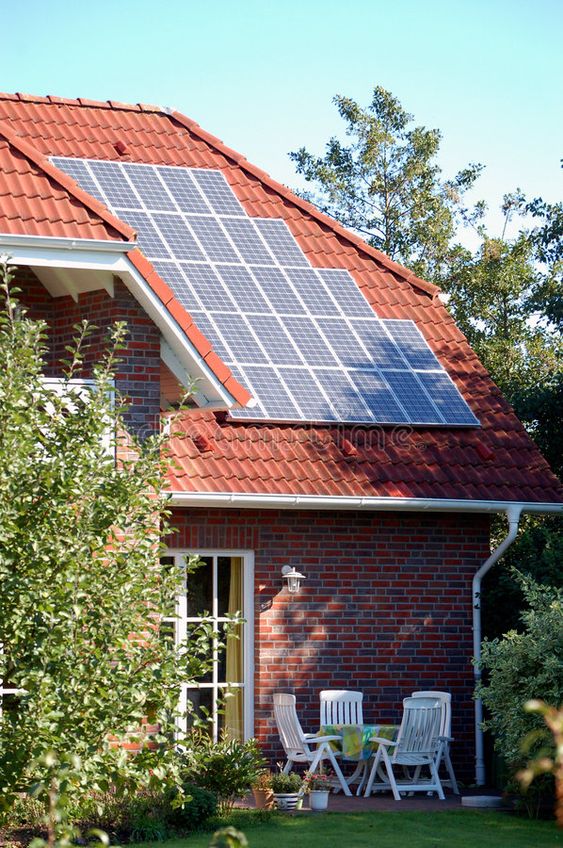
Finding the optimal tilt
The tilt has a significant effect on their efficiency, with the position of the Earth relative to the Sun, which varies over the year, playing a big role. In winter, tilting the panels at a steeper angle would therefore be most effective, while in summer you would produce the most electricity with panels tilted only slightly, at around 15°. With this in mind, 35° is usually recommended as the optimal panel tilt for the Czech Republic, which in practice is just as good as the exact year-round optimum.
The PVGIS calculation for Prague gives an optimum of 39°. However, annual output differs from a 35° tilt by less than 2 kWh per 1 kWp, which is less than 0.2%. Even a 30° tilt produces only about 1% less per year than the optimum, so a range of 30 to 40° is fine for a family house.
What panel tilt is best for winter?
The sun is low in winter, so steeper panels catch more light. According to PVGIS, in Prague panels at a 60° tilt produce about 18% more in December than at 35°. Over the whole year, however, they produce about 5% less, because they lose out in summer. Panels on a façade, in other words vertical ones, still produce more in December than at 35°, but around 29% less over the year.
| Panel tilt (south, Prague) | December, kWh per 1 kWp | January, kWh per 1 kWp | Whole year, kWh per 1 kWp |
|---|---|---|---|
| 0° (horizontal) | 16 | 21 | 916 |
| 15° | 26 | 30 | 1 027 |
| 35° | 36 | 40 | 1 093 |
| 60° | 42 | 46 | 1 039 |
| 90° (façade) | 41 | 43 | 776 |
You do not need to tilt the panels more steeply than the roof just for winter. A steeper tilt pays off mainly where the aim is to maximise winter output, for example at a holiday cottage or a house with a heat pump. Horizontal or only slightly tilted panels on a flat roof produce less than half as much in December as panels at a 35° tilt, and snow slides off them less easily.
To clean or not to clean
Over time, a film of dirt such as dust, pollen or bird droppings can form on the panels. This reduces the efficiency of solar panels, in Czech conditions usually by a few per cent a year, and more for panels at a low tilt or in dusty surroundings.
A European study by scientists from the German Aerospace Center (DLR) and other institutions (Fernández Solas et al., Renewable Energy, 2025) estimates the average annual loss from soiling in Europe at 0.9 to 5.3%, depending on how effectively rain washes the panels. That is why many people in the Czech Republic do not bother with regular cleaning of solar panels. They do not want to spend extra money on maintenance, and rain washes away much of the dirt.
Note that at a tilt of less than 15°, the panels will need regular maintenance. If they are not tilted enough, even larger bits of dirt will not slide off them on their own.
If you decide on cleaning the panels, we definitely recommend leaving it to professionals and paying a little extra rather than trying to do the maintenance yourself. Improper cleaning or snow removal risks damaging the panels and, above all, injuring yourself. Professional companies work from an aerial work platform and clean with demineralised water at low pressure and a soft brush, so that limescale does not form on the panels and the glass is not damaged. Panel manufacturers’ cleaning instructions assume low-pressure water, with one of them specifying a maximum of 35 bar at the nozzle. Various types of panel coating are also used to ensure that dirt does not stick to the surface as much.
A photovoltaic cleaning expert also carries out a visual inspection and, during maintenance, can spot whether the panels or other components of the system are damaged or not properly secured. Regular inspection therefore uncovers a fault before it reduces output or threatens safety.
When winter brings advantages
Less sunlight means less electricity generated. However, winter also brings one advantage: the cold, in which panels work more efficiently.
The efficiency of solar panels rises in winter, by approximately 0.4% for every °C. How is that possible? Low temperatures help the photovoltaic effect, which takes place in the photovoltaic cells inside the panels.
Photons striking a photovoltaic cell release electrons in the silicon. These start to move and an electric current is created. The output of a panel is the product of current and voltage.
In warm conditions, spontaneous recombination of charges in the silicon increases, so the cell voltage falls and output falls with it. In the cold the opposite happens, so the output of photovoltaic panels in winter is higher under the same irradiance.
What is the temperature coefficient and why does frost not harm panels?
The output stated on the panel’s label applies to standard test conditions, that is, a cell temperature of 25 °C and solar irradiance of 1,000 W/m², as Fraunhofer ISE also points out. How much the output changes at a different temperature is shown by the temperature coefficient of power, which you will find in the panel’s datasheet in %/°C with a minus sign. The educational portal PVEducation (Christiana Honsberg and Stuart Bowden) states a drop in output of 0.4 to 0.5% for every °C for silicon cells.
With a coefficient of −0.4%/°C, a panel with a cell temperature of 0 °C will deliver about 10% more than its rated output under the same irradiance. When the cell heats up in the summer sun to, say, 60 °C, it delivers about 14% less. Note that a panel in the sun is always warmer than the surrounding air, so even in frost the cell warms up a little.
Frost itself does not harm the panels. However, voltage rises at low temperatures, by roughly 2.2 mV per cell for every °C according to PVEducation. The designer therefore calculates the maximum voltage of the panel string for the lowest temperature at the site, so that it does not exceed the inverter’s input voltage. With a professionally designed system you do not need to deal with this, but with DIY setups you do.
How does a battery behave in winter?
In winter, the battery only charges fully on sunny days. A 5 kWp system in Prague generates just under 6 kWh on an average December day, and the house uses most of that straight away during the day. Little is left for charging the battery, and often nothing. In winter, the battery mainly serves to shift the midday surplus into the evening.
Temperature also matters. According to the Battery University guide (BU-410), standard lithium-ion cells must not be charged below 0 °C, because metallic lithium is deposited on the electrode, permanently reducing both performance and safety. They can be discharged even in frost, from roughly −20 °C. Therefore place the battery in a frost-free area and check the conditions in the manufacturer’s datasheet. We cover how photovoltaics with battery storage works in a separate article.
A home battery stores energy for hours, not months. It cannot physically carry summer surpluses over to winter. That is what a virtual battery is for, meaning a supplier service that credits surpluses against later consumption. However, only the commodity part of the electricity is offset. According to E.ON, for electricity drawn from a virtual battery you still pay the regulated part of the price, that is, distribution, fees and taxes.
During a grid outage, a standard grid-tied inverter disconnects for safety reasons and the system does not generate, even when the sun is shining. The house can then only be powered by a system with a backup mode, meaning an inverter with a battery and backed-up circuits. We look at how much a system costs with and without a battery in our article on the real cost of photovoltaics for a family house.
Can photovoltaics cover a heat pump in winter?
In the coldest months, only a small part. Heat demand is highest precisely when there is least sunlight, a mismatch that Fraunhofer ISE also points out. December and January provide only a small part of the system’s annual output, while the heat pump consumes the most at that time. In winter you will therefore draw most of its electricity from the grid. We look at what consumption to expect in our article on how much electricity a heat pump uses.
The combination still makes sense. According to Fraunhofer ISE, a heat pump achieves an average annual coefficient of performance of around 3, and less in frosty weather. From 1 kWh of electricity it therefore produces roughly 3 kWh of heat on average. In spring and autumn, when heating is still needed and the panels already generate significantly more than in December, photovoltaics covers a larger part of its operation, and it helps with water heating all year round. Surpluses can be stored in a buffer tank or hot water cylinder, which according to Fraunhofer ISE increases self-consumption mainly in the summer half of the year.
Without a battery, surpluses are sent to water heating by a surplus controller, which diverts them to the heating element in the water heater instead of the grid. In winter it helps to schedule heating of the water or buffer tank for midday, when the panels are generating. You will find more about this combination in our article photovoltaics and heat pumps: experiences.
Calculate the payback period from annual output, not from winter. Assess investing in photovoltaics like any other long-term investment, over the entire lifetime of the system.
Leave a Reply