
The mysterious Casa batlló
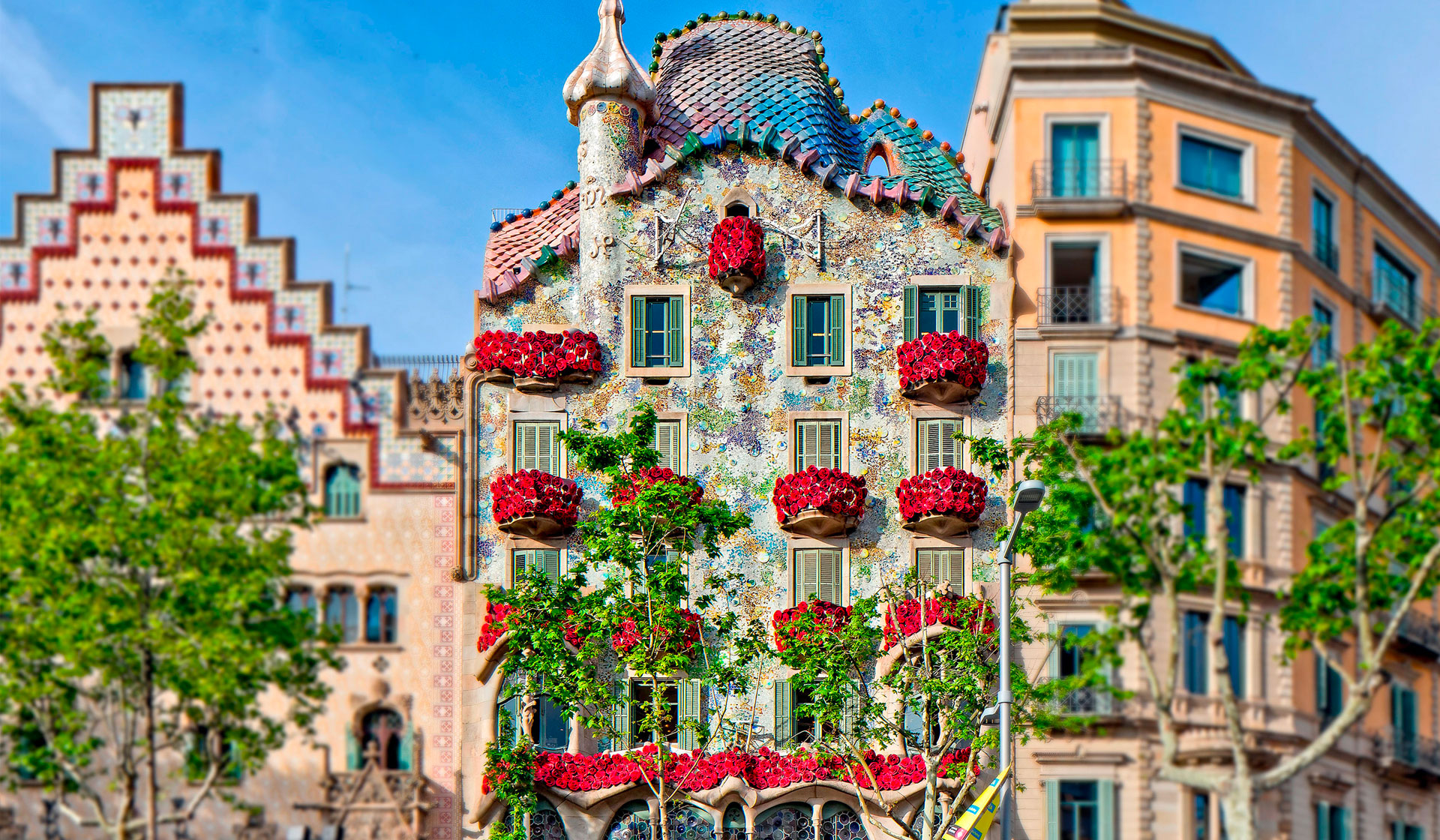
We have already written to you about Spain and about life on the fringes of society. Even so, we have moved to Spain once again, and this time we have chosen an article that suits the autumn season. It may haunt you, frighten you or fascinate you, but it will certainly draw you in with its appearance and irregular lines. We are talking about one of the strangest buildings in Europe. The mysterious Casa Batlló has stood in Barcelona for 115 years. Locals call it either the “House of Bones” or the “House of the Dragon”, because of its façade, which resembles a dragon’s scales. You have surely heard of the architect himself. He is Antoni Gaudí, the builder of many buildings, yet this one is probably the most controversial of them all.
It shines by day and by night
Bright rays of sunlight touch the sandstone façade, which is covered with a fine mosaic. If you look at it more closely, it may remind you of Monet’s famous paintings of water lilies. The mosaic was made from broken glazed tiles and shards, known in Spanish as “trencadís”, and its colours range from gold to greenish blue. That is why, at first glance, it looks like algae or water lilies on a lake. Casa Batlló has both logic and the necessary geometry. When darkness falls, the whole house looks even more monstrous, enigmatic and mysterious.
The six-storey house is divided into 3 parts. The lower part has a two-storey gallery with large windows. The second part, the so-called middle, is surrounded by colourful projecting balconies. The columns that wind around them resemble bones. Their shape can also evoke the teeth of a dragon. The last part is the top. It is a tower with a cross and chimneys beside it. At the top of the tower are the monograms of the Holy Family: Jesus (J), Mary (M) and Joseph (JHF).
The whole building is crowned by a brightly coloured roof which, like the façade, resembles a dragon’s scales. Casa Batlló has almost no straight lines.
Dazzled by a play of light
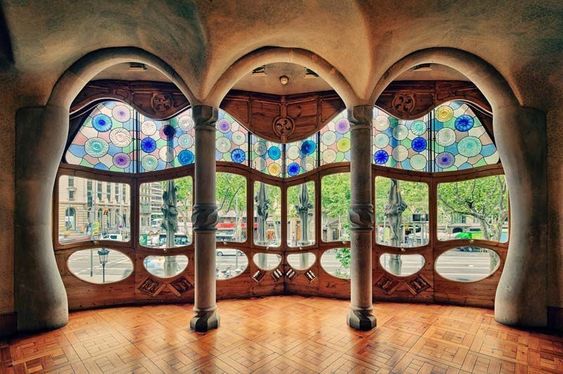
As soon as you step inside, you become a witness to a play of lights. Gaudí wanted you to feel that way, because that was simply his era and who he was. He admired colours and mosaics. Both in the exterior and interior, you will find no corners. Everything is modelled so that there are no edges here. Art Nouveau was about decoration, plant motifs and a prominent skeleton. This house possesses and fulfils all of this from the inside as well. At the time when Gaudí lived, it was common to connect individual rooms. You walk through them and are surrounded by colours ranging from blue to gold. You are drawn in by the shapes that surround the space. In addition, Gaudí contrived to relocate central heating into the house, and thus the house became one of the first with this system.
The owner broke all the rules
Although as a visitor you only get to the first floor, you still cannot miss another mystery. And that is the staircase, which resembles a long curved spine. It leads all the way up to the top floor. And it also brings you to the expansive terrace, which today serves as a viewpoint for visitors. It was precisely in these spaces that the owner of the building himself moved about. He was the businessman Josef Batlló. He hired Gaudí to demolish the house first. However, Gaudí persuaded him to undertake a renovation, which dragged on until 1906. Although the two of them were not inspired by our article on acquiring a building plot, the house still had decent prospects. After the death of Josef Batlló, the house passed into the ownership of his wife and subsequently his family.
Nobody, neither the owner nor Gaudí, had any idea what a controversy they would provoke. The whole of Spain could not come to terms with such a “monstrosity” and frequently made its opinion known. But Gaudí saw a dream, and he pursued it. After all, all his buildings are visible and unusual. He was not afraid of new things, and probably even today his style would be debatable. Over time, Spain came to terms with this building as well, and the mysterious house became a popular attraction mainly for tourists. In 2005, UNESCO added the building to the World Heritage List. So, whenever you want to acquire an atypical house, this building can be an interesting inspiration for you. Building a house is indeed an attractive and long-term investment. Gaudí’s words would probably sound like this: “DO NOT BE AFRAID!”
Leave a Reply