
How to grow black-eyed Susan
It is one of the most popular annuals that follow the sun. It loves garden walls that it can climb. So what are we talking about? If you do not know the black-eyed Susan and you like perennials, this eye-catching little plant is sure to interest you. The good news is that it does not only come in canary yellow. In a good garden centre you will also find cream or light brown varieties, and rest assured that these will suit your garden too.
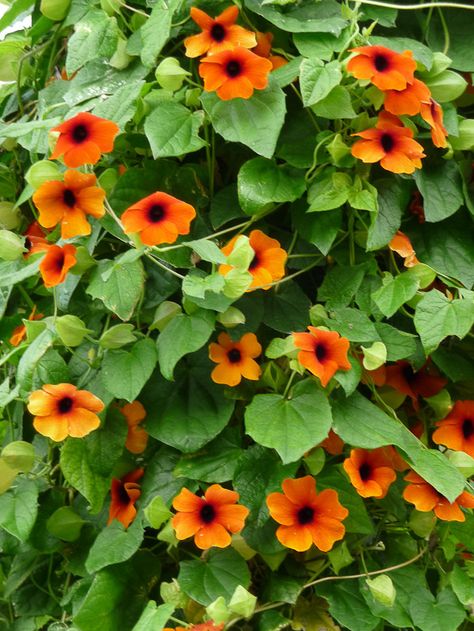
The flower is made up of five petals and a striking centre, which is most often dark. The plant grows very fast, and if you add some fast-growing shrubs, you will very soon have an interesting screen. Try it next to a pergola, for example.
Behind every flower is Africa
Yes, the black-eyed Susan also comes from Africa, specifically from the east of the continent. Thanks to the constant warmth, it thrives much better there, growing as an evergreen climber without any special care. In our part of the world, we can enjoy it mainly in the summer months.
It is a popular annual.
It has narrow heart-shaped leaves, and once the plant spreads, it forms a compact surface that shows off the beauty of its bright flowers very well. Here it flowers only from May to October, and to make it bloom beautifully, it is best to feed it now and then. Try banana fertiliser, for example. As a result, you can expect shoots up to 2 m long. However, if you decide to plant it in a pot, you will more likely have to wait until June for flowers.
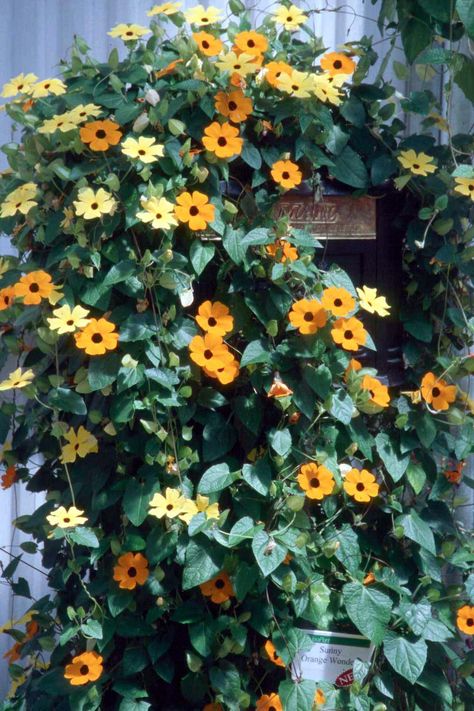
As a point of interest, it belongs to the genus Thunbergia, which includes up to 152 species. You will find it not only in Africa, as we have already mentioned, but also from Madagascar, China, Indochina and South-East Asia, all the way to New Guinea and north-eastern Australia.
Growing black-eyed Susan
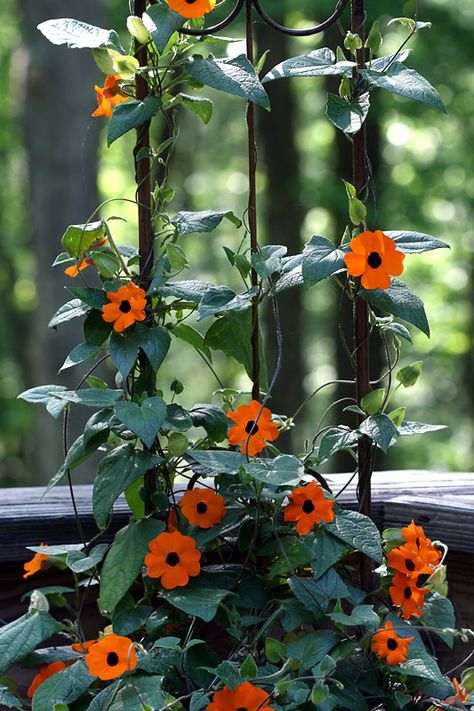
It is not fussy. It prefers humus-rich soil, but you can also try it in drier soil. What it definitely loves is blazing heat. If you have a spot where the sun shines all day, it will be happiest. It also looks lovely covering a fence or pergola, or on other features in the garden and around the house, and there are no limits to your imagination. Even so, protect its spot from wind. If you bought it from a garden centre in March, for example, it is better to wait until May, and then it will flower for you all summer and into September.
How to propagate black-eyed Susan
You will sometimes see seeds in garden centres, but woody plants propagate much better from mature tip cuttings. These do not yet need to be fully woody. It is enough if the last two pairs of leaves are mature. When taking a cutting, also make sure that there are at least two pairs of opposite buds on its stem. Carefully snap off the bottom pair of leaves or remove it with scissors, and then plant the cutting in clean horticultural perlite. Do not forget to use horticultural perlite and peat in a 1:1 ratio. Cover the container with the cuttings with a plastic bag to increase humidity, and place it in light partial shade in a warm spot. Wait until the cuttings take root. Once they are strong enough, transplant them into a nutrient-rich compost and move them to a sunny spot.

Keep an open mind and do not be afraid of this new annual. In time, your black-eyed Susan may even attract a black bee, which will add a little more interest to your garden.
Leave a Reply